

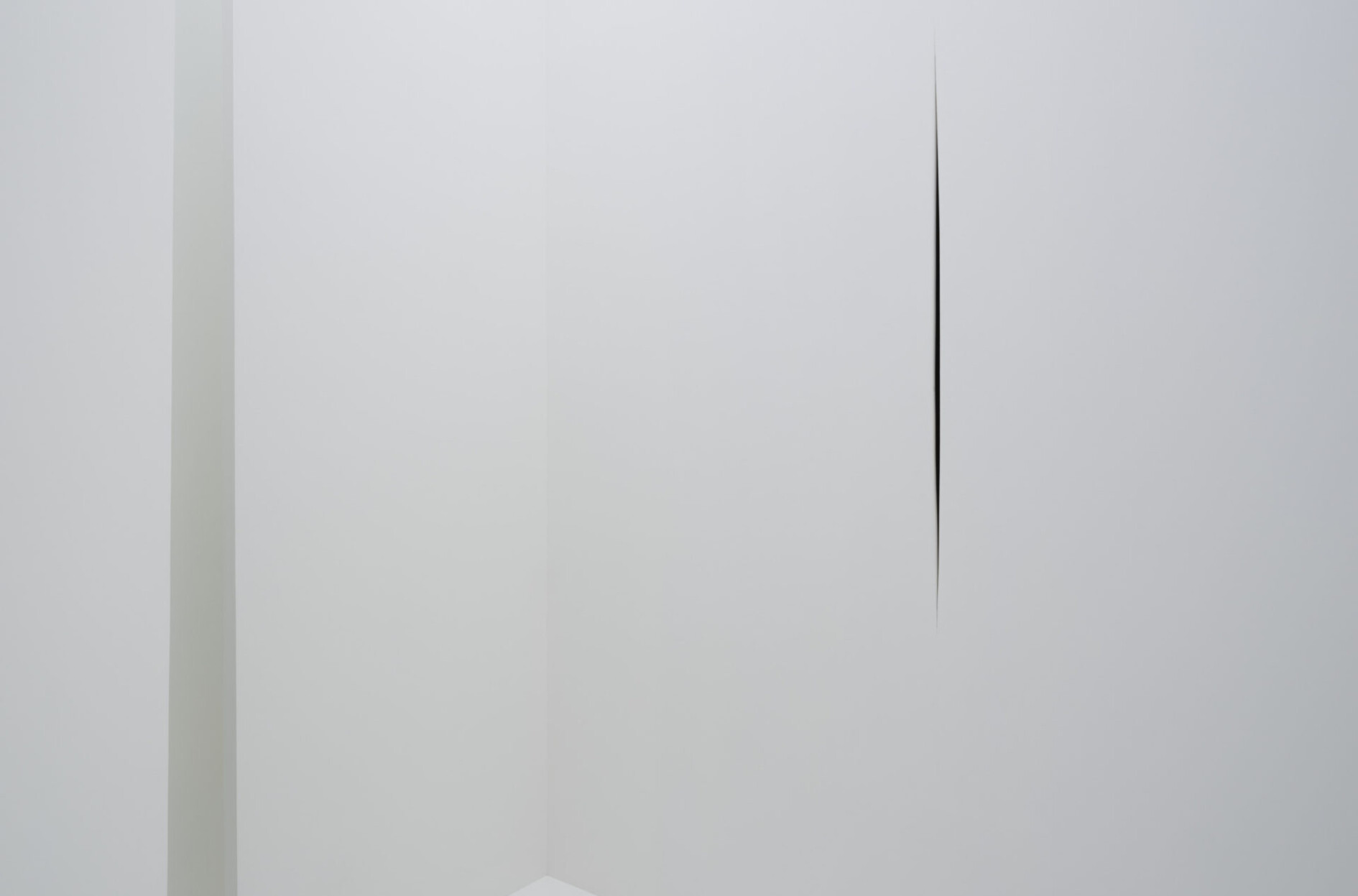
Lucio Fontana (1899–1968) was one of the 20th century’s most important avant-garde artists and continues to inspire artists, designers and architects to this day. He is best known for his iconic slashed paintings, but Fontana’s work goes much further than that. He was a sculptor by training, created spatial installations, collaborated with architects and designed jewellery. The collection of his jewellery and ceramics at Design Museum Den Bosch (the largest holding of Fontana’s work in the Netherlands) forms the basis of Lucio Fontana – The Conquest of Space, which centres on the artist’s revolutionary Concetto spaziale (‘spatial concept’).
The exhibition complements the museum’s own collection with paintings, sculptures and light objects from the Netherlands and abroad. Fontana’s Ambienti spaziali are being shown in this country for the first time since 1967. The ground-breaking mid-century spatial installations have been reconstructed at the museum with the approval of the Fondazione Lucio Fontana. It means visitors will be able literally to enter Fontana’s space(s).
The photographers Anuschka Blommers and Niels Schumm have reshot Fontana’s work in the Design Museum Den Bosch collection especially for the exhibition. The result is an off-kilter, suggestive series of pictures in which the duo offer their contemporary take on Fontana’s work.
Spatial total experiences
Many people know Lucio Fontana primarily for his paintings. Less well known is that he was already creating groundbreaking spatial installations in the 1940s, his Ambienti spaziali. In these installations, Fontana integrated architecture, design, sculpture, painting and drawing. Fontana used new technical inventions such as fluorescent paint, black light and neon light. The Ambienti are three-dimensional paintings, spatial drawings or sculptural architecture. Fontana made no fundamental distinction between the various visual disciplines. On the contrary, he sought to unite them in all his work. In this way, he advocated an art that, by making use of all new possibilities, could relate to the modern age. For the first time since 1967, these spatial installations can be seen again in the Netherlands.
The absolute apotheosis
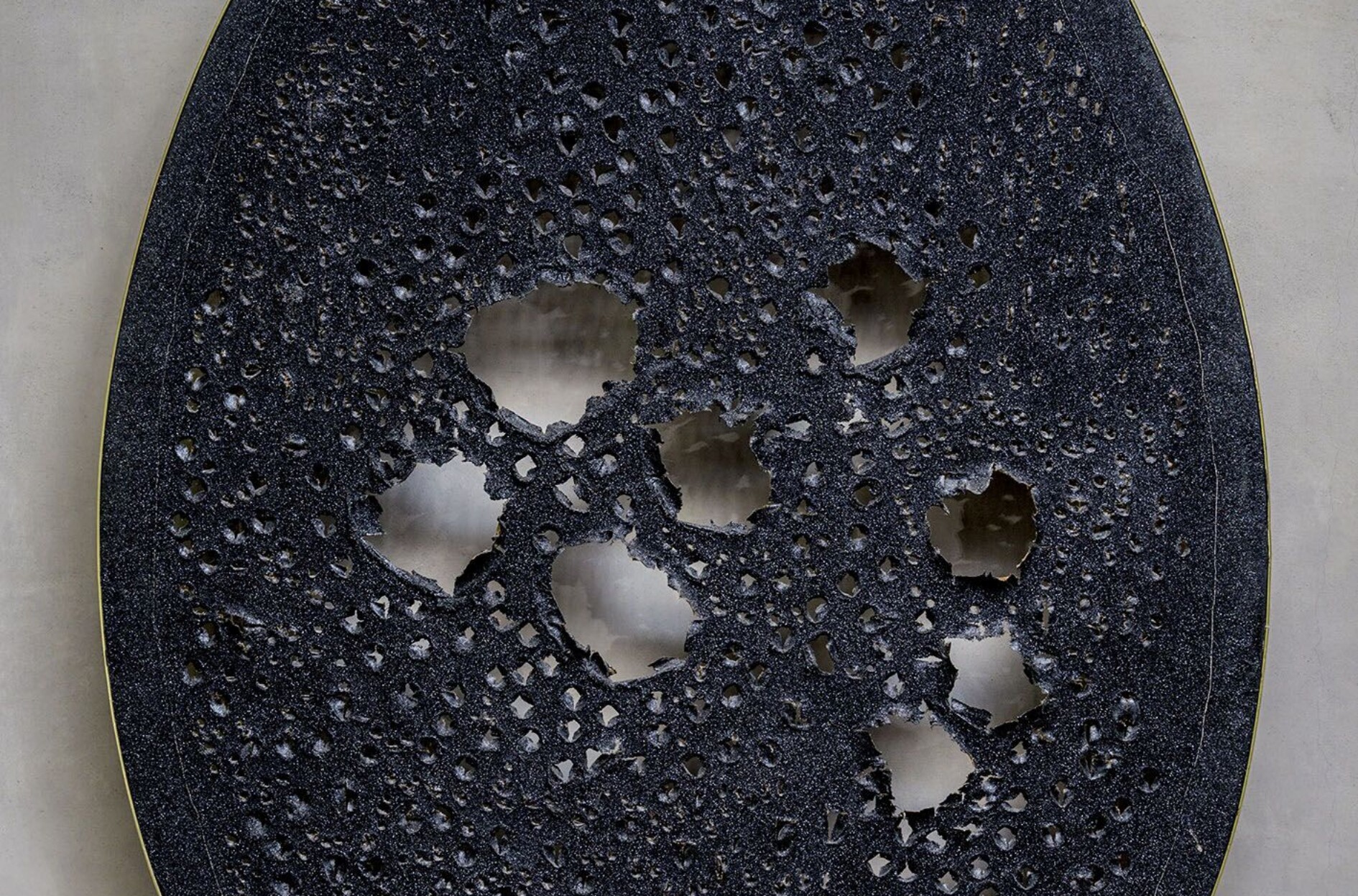
The starting point for the exhibition is the collection of Design Museum Den Bosch. It consists of twenty pieces of ceramics and jewellery, making it the largest collection of Fontana’s work in the Netherlands. For the exhibition, the collection has been supplemented with highlights from Fontana’s oeuvre from home and abroad. The internationally renowned Galerie Karsten Greve (St Moritz, Paris, Cologne) has loaned unique drawings and ceramics, and three large spatial installations have been reconstructed in collaboration with the Fondazione Lucio Fontana. An absolute apotheosis in Fontana’s work and a highlight of the exhibition is the egg-shaped painting La fine di Dio from 1963, from a private collection. The black perforated canvas of this painting is covered with star-like glitter. It is an astral egg with which Fontana expresses an idea about the infinity of space and the inability, in an age of technological progress and the first space voyages, to depict God as an old man with a grey beard. The exhibition is a unique and once-in-a-lifetime opportunity to view this work in the Netherlands.
A comprehensive concept of space
What connects all the works in the exhibition is that they show Fontana’s search for a new concept of space. With his holes in the canvas, he broke through the flat surface and the illusion of spatiality that traditional painting attempts to imitate. With his spatial installations, paintings, ceramics, sculptures and jewellery, he liberated visual art, design and architecture from their traditional limitations. Together, all these works provide insight into Fontana’s conquest of space at a time when humanity was entering cosmic space.
Design Museum Den Bosch shows the full scope of Fontana’s imagination in a concise, stunning exhibition.
A fresh look at the collection
Especially for this exhibition, the museum asked photography duo Anuschka Blommers (1969) and Niels Schumm (1969) to re-photograph Fontana’s collection of works. Blommers and Schumm are best known for their fashion and portrait photography for leading magazines such as Vogue, Vanity Fair, Wallpaper, Dazed & Confused and Another Magazine. Their photography is also exhibited as autonomous work, including at the Groninger Museum. Like Fontana, Blommers and Schumm operate at the intersection of visual and applied art. With this commission, the museum has asked two contemporary image makers to take a fresh look at Fontana’s work. The result is an alienating, suggestive photo series that is completely contemporary and sheds new light on Fontana’s work. The photos will be on display on high light boxes in the museum lobby during the exhibition. The photo series was made possible by a contribution from the Mondriaan Fund’s Art Commission scheme.

During this journey through Fontana’s imaginative world, you will be amazed at every turn. Without a doubt one of the best exhibitions at the Design Museum to date.
In this livestream, curator Colin Huizing and moderator Maan Leo discussed the life and work of Lucio Fontana and took you through the highlights of the exhibition. Please note: this conversation is in Dutch.
Publication
The exhibition Lucio Fontana – The Conquest of Space is accompanied by a book produced by Design Museum Den Bosch in collaboration with nai010 publishers. Besides a survey of all the works in the exhibition, it includes essays by the curator Colin Huizing and the art historian Paolo Campiglio. It also features all of Anuschka Blommers and Niels Schumm’s photographs of the museum’s Fontana collection. The book is available for €24.95 at the museum, in good book shops and via the nai010 website. The publication was made possible in part by contributions of Gifted Art, the Hendrik Muller’s Vaderlandsch Fonds and the De Gijselaar-Hintzenfonds.
Curator and design
The exhibition has been compiled by guest curator Colin Huizing, formerly a senior curator at the Stedelijk Museum Schiedam, co-curator of the Dutch entry for the 2015 Venice Biennale (herman de vries: to be all ways to be) and creator of exhibitions for various museums and other institutions. The exhibition design was made by Thomas Bennen.


