How do you modernize a religious tradition that is more than 1,400 years old? This was the question Dr. Mahmoud Bodo Rasch faced in 1974. He was in Saudi Arabia, studying the Hajj together with his friend Sami Angawi. Angawi, a Saudi architect, had met Rasch in 1973 at the University of Texas, where the recently-graduated German architect was teaching. Through Angawi, Rasch came into contact with Islam — and something inside him shifted.
Rasch had always been a spiritual seeker, looking for something beyond the atheism of his upbringing. He explored Christianity, spent time as a hippie hanging around Vondelpark in Amsterdam, and by the time he met Angawi, had reached what he considered a spiritual turning point. Once in Saudi Arabia, he converted to Islam and took the name Mahmoud.
At that same time, Rasch and Angawi were given a commission by the deputy governor of Mecca to study and document the Islamic pilgrimage — the Hajj. The pilgrimage, which is obligatory for Muslims, was outgrowing its infrastructure, leading to accidents and even fatalities.
The Hajj needed to be modernized. In this context, modernization meant aligning a phenomenon with the demands of the present time. The Hajj consists of a series of rituals that must be performed in a specific order and within a fixed timeframe which cannot be altered under any circumstances. The modernizations had to allow people to fulfill their religious duties more safely and easily.
One of the projects Rasch worked on (together with Angawi and Frei Otto) was the tent city of Mina — the largest temporary tent city in the world. His plan for Mina eventually became the subject of a doctoral dissertation, which earned him his PhD in 1980. However, the implementation of the plan did not occur until 1997, following a devastating fire that claimed the lives of 340 pilgrims.
Hajj
The Hajj is the Islamic pilgrimage that Muslims are required to perform once in their lifetime, provided they are able to do so (financially, physically, and mentally). It is one of the five pillars of Islam, which form the foundation of the faith. The other four pillars are:
Shahada – the declaration of faith
Salat – performing the five daily prayers
Sawm – fasting during the month of Ramadan
Zakat – the obligatory giving of a portion of one’s wealth to the poor
The Hajj takes place during the Islamic month of Dhul-Hijjah, the last month of the Islamic lunar calendar. Because this calendar is based on the phases of the moon, an Islamic year is eleven days shorter than a Gregorian year, which is the current global standard. In 2026, Dhul-Hijjah will fall between May 18 and June 15.
The Hajj is held in and around Mecca in Saudi Arabia and lasts five to six days. During those days, pilgrims must complete a series of rituals in a specific order (see infographic). In 2025, 1.6 million pilgrims from 171 countries took part in the Hajj, whereas in 2012, the highest number ever was recorded: nearly 3.2 million pilgrims.
Welcoming and managing such a vast number of people is a massive logistical operation. It is therefore not surprising that accidents have occurred over the years, sometimes with fatal consequences. One of the most frequent causes of death has been stampedes, triggered by panic in large crowds. Urban planning and infrastructure improvements have helped reduce such incidents. Another growing risk is extreme heat, which has become increasingly dangerous. Architectural interventions are now also being used to mitigate that threat.
Mecca
Mecca is the center of Islam. This fact is so defining that the expression “the Mecca of…” has become a widely used phrase. The city is the birthplace of the Prophet Muhammad and is home to several Islamic holy sites, such as the Kaaba, Jabal al-Nour (the mountain where the Prophet received his first revelation), and the sacred Zamzam well. Even in pre-Islamic times, Mecca was an important center on the Arabian Peninsula. It was a crossroads of many trade routes and already served as a pilgrimage site, where various Arab tribes would come each year to visit the altar of their own deity.
The Prophet Muhammad began preaching Islam in Mecca, but soon had to flee when the city’s most powerful families could no longer tolerate his message. He fled to Medina and returned years later to conquer the city. One of the first things he did was to destroy the 360 idols inside the Kaaba — but he chose to preserve the tradition of the annual pilgrimage.
Today, Mecca is one of the most visited cities in the world, due to the annual Hajj (the major pilgrimage) and the ongoing Umrah (the minor pilgrimage). To accommodate the millions of visitors, the city is in a state of constant expansion. This is a challenging task, as Mecca is surrounded by mountains, which limits space. As a result, many historic buildings have been demolished and replaced by high-rise structures offering accommodation and various facilities for pilgrims.
Text continues after the photo.
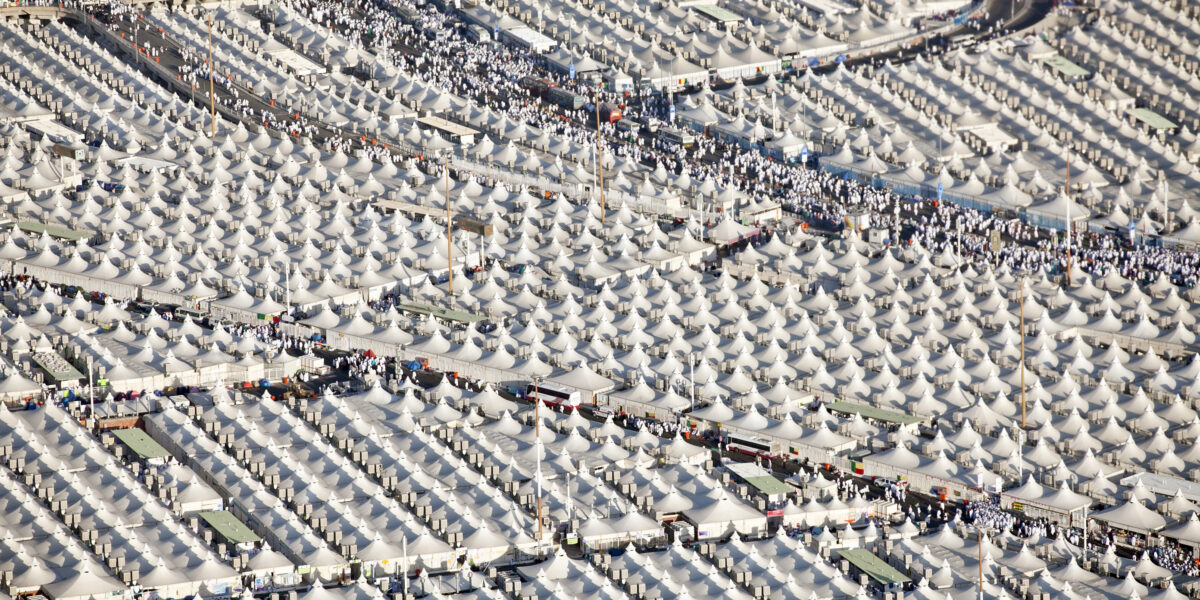
Tents for pilgrims in the valley of Mina, designed in 1997 by Dr Mahmoud Bodo Rasch. Photo SL Rasch GmbH
Medina
Although Medina is not officially part of the Hajj, it is still an important stop for many pilgrims. Located 440 km north of Mecca, its full name is Al Madinah al Munawwarah, meaning “The Radiant City.” It is also known as Madinat An-Nabi – “The City of the Prophet.” This refers to the Prophet Muhammad, who fled there in the year 622 to escape the powerful polytheistic families in Mecca who rejected his teachings about the one God. Together with his followers — many of whom were poor or runaway slaves — he sought refuge in the town of Yathrib, which was later renamed Medina. This oasis city became the center from which Islam began to spread.
Medina is home to several holy sites that draw large numbers of pilgrims. These include:
The Quba Mosque, the first mosque ever built
The Prophet’s Mosque (Al-Masjid an-Nabawi), which serves as a community center and court
The tomb of the Prophet Muhammad
Mount Uhud, the site of a significant battle in Islamic history
Medina is also the city where Dr. Mahmoud Bodo Rasch’s most important architectural works are located: the giant retractable umbrellas inside and around the Prophet’s Mosque, and the sliding domes of the mosque’s roof.
Mina
The Valley of Mina lies about 8 kilometers southeast of Mecca. It is the site of the Jamarat (the stoning of the devil) and the sacrifice of a sheep — two key rituals during the Hajj. Pilgrims spend several nights here in what is known as the largest tent city in the world.
In Islamic tradition, this valley is the place where the Prophet Abraham was commanded by God to sacrifice his son Ishmael. At the last moment, God intervened and replaced Ishmael with a sheep, marking the origin of the Festival of Sacrifice (Eid al-Adha). As Abraham prepared to carry out the sacrifice, he was disturbed by the devil. God ordered Abraham to stone the devil — a deed that is commemorated in the ritual of Jamarat. During this ritual, pilgrims throw seven pebbles three times at three separate walls that symbolize the devil. With each pebble cast, the pilgrim symbolically casts away selfish desires. Originally, the stones were thrown at three pillars, also called Jamarat. However, these pillars often led to dangerous situations — including crushes and people being accidentally hit by stones. In 2004, the pillars were replaced with three 26-meter-long walls to improve safety.
The Jamarat ritual takes place over the span of three days. During this time, pilgrims sleep in one of the 100,000 tents set up in the valley. In earlier times, pilgrims brought their own tents. Later, the government provided cotton tents — until 1997, when a massive fire broke out, killing over 340 people. After the fire, the cotton tents were replaced by new tents designed by Dr. Rasch, based on a concept he had already developed in 1979. These tents are made from fireproof fiberglass fabric coated with Teflon. The walls and roof are supported by a steel frame anchored in a concrete foundation. Measuring 8 by 8 meters, the tents are modular and equipped with air conditioning. For the design, Dr. Rasch drew inspiration from the original appearance of the traditional Hajj tent.
Text continues after the photo.
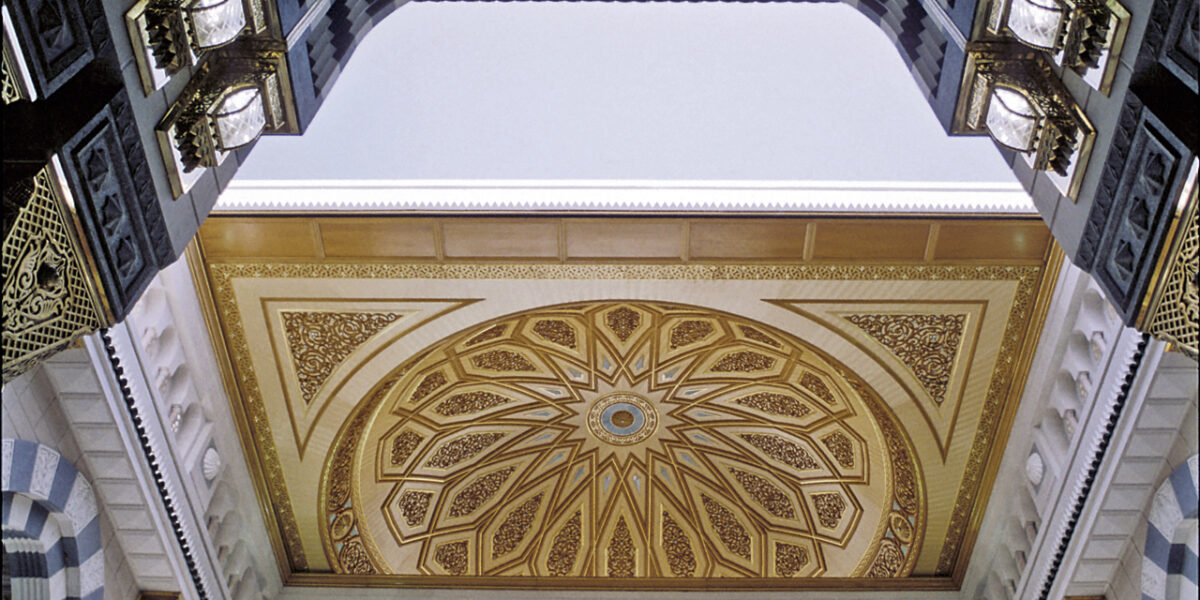
Sliding Domes for Al-Masjid al Nabawi (the Mosque of the Prophet) in Medina, designed in 1992 by Dr Mahmoud Bodo Rasch. Photo: SL Rasch GmbH.
Sliding domes
During the second major expansion of the Prophet’s Mosque in Medina (see the text about the umbrellas), 27 movable domes were installed in 1992. These domes slide aside in the evening along guide rails, allowing heat to escape and cool air to enter the mosque. The exterior of the domes is crafted using high-tech laminated composite materials such as carbon and glass fibers, combined with ceramic tiles and a steel frame. The interior features handcrafted Moroccan gilded woodcarvings, inlaid with amazonite, a green mineral stone. The domes can open in 72 seconds and each weighs 80 tons.
Text continues after the photo.

Photo Ben Nienhuis
Umbrellas
Al-Masjid al Nabawi or the Prophet’s Mosque in Medina, is the second-largest mosque in the world, after the Masjid al-Haram in Mecca was the second mosque built in Medina in 632 by the Prophet Muhammad, but it immediately became the most important, as it also served as the gathering place for the emerging Muslim community. It was not only a place for communal prayer, but also a center for teaching and judicial matters. In the years follwoing the Prophet’s death, the mosque underwent various renovations and expansions. Every new ruler would remove or add elements to the building.
In 1974, King Faisal of Saudi Arabia decided to expand the mosque by 40,440 square meters. A second expansion followed in 1984, eventually increasing the mosque’s size to 160,000 square meters. This expansion was so extensive that it wasn’t completed until 1992. As part of the expansion, two courtyards were created, and in 1991, Dr. Rasch designed 12 large umbrellas for them. When opened, these umbrellas reach a height of 14 meters, with a span of 24 meters each, providing shade over the courtyards when the sun is high. The shade cools the area, and cold air also flows out of the supporting columns. In winter, the umbrellas open in the evenings to help retain warmth during Medina’s cold nights. Depending on the position of the sun, the umbrellas automatically open and close. They are covered with a specially designed Teflon-coated fabric.
Despite the many expansions, Al-Masjid an-Nabawi still proved insufficient for the ever-growing number of pilgrims. Many worshippers prayed in the open plaza in front of the mosque. As a result, plans were soon made to partially cover the esplanade as well. Dr. Rasch’s firm, SL Rasch, developed a new type of umbrella, providing shelter and shade to a space where 250,000 people can pray. Today, the plazais home to 250 of these umbrellas.
Text continues after the photo.
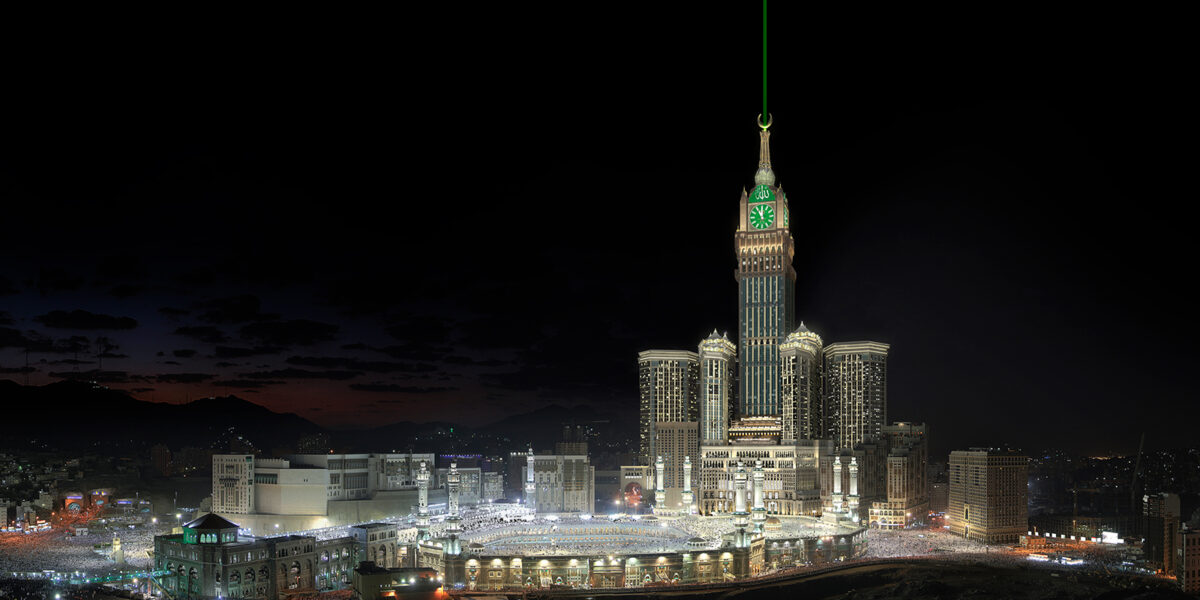
Abraj as-Sa’at (the Towers of the Clock) in Mecca, designed in 2012 by Dr Mahmoud Bodo Rasch. Photo: SL Rasch GmbH.
The Clock Towers
In 2002, the first stone of the King Abdul Aziz Endowment Project was laid by King Abdullah bin Abdulaziz himself. This complex of seven towers, with a total of 1.5 million square meters of floor space, was built directly in front of the main gate of the Grand Mosque in Mecca. It was a mega-project that included hotels, shops, and conference facilities. In 2006, when construction was already well underway, a decision was made to add the largest clock tower in the world to one of the towers. Since the foundation had not been designed to support such a structure, the construction needed to be ultralight — the tower could not exceed 82,000 tons.
The firm founded by Dr. Rasch, SL Rasch, was chosen for the job. It specialized in lightweight structures (SL stands for Sonderkonstruktionen und Leichtbau — special structures and lightweight construction). Designing and building the tower required a highly diverse team across many disciplines. The tower itself stands 307 meters tall and, combined with the building it sits on, reaches a total height of 607 meters. The two largest of the four clock faces have a diameter of 43 meters, and the hands are 22 meters long. The hands needed to be extremely stiff and strong due to the intense winds at this altitude. They are therefore made of carbon fiber by a company that builds superyachts. Moreover, they are hollow; a person can stand inside them. The clock’s mechanism weighs 21 tons and was built by the South German clockmaker Perrot. The installation of the mechanism had to be guided over the phone by the Perrot team, as Mecca is forbidden to non-Muslims. The tower’s spire houses a control center and a moon observatory. At the very top of the spire sits a crescent moon containing a prayer room.
The entire complex is officially called Abraj al-Sa’at (The Clock Towers), and it has been controversial from the beginning. Even before the Mecca Clock Royal Tower was added, there were international protests over the demolition of a 17th-century Ottoman fortress to make room for the towers. To much of the local population, however, the fort was seen as a symbol of Ottoman domination. Opinions on the clock tower itself are divided among Muslims:
some feel it overshadows the Kaaba, while others see it as a symbol of a new, modern Islamic spirit.
Mecca
If Mecca is the center of Islam, then the Kaaba is its absolute center. It is the focal point that Muslims around the world face during their five daily prayers. This does not mean that the cube-shaped structure, draped in black silk, is worshipped itself — rather, it serves as an architectural focal point that provides a spiritual anchor.
In addition to indicating the direction of prayer, the Kaaba also plays a central role during the Hajj. At various moments, pilgrims walk seven times counterclockwise around the Kaaba in a ritual known as Tawaf.
According to Islamic tradition, the Kaaba was built by the Prophet Abraham and his son Ishmael. At the spot where Abraham is said to have stood while building the Kaaba, two large footprints are visible. These are protected by a metal enclosure known as the Maqam Ibrahim, which has been redesigned multiple times over the centuries. For a long time, the structure was covered with a richly decorated cloth called the Sitara. The current Maqam Ibrahim was designed by Dr. Rasch.
The Kaaba is 15 meters high and each side measures 12 meters in length. It features a door, located 2.13 meters above ground level, which can be accessed via a movable staircase. This staircase is mobile so as not to obstruct pilgrims during Tawaf, and is periodically replaced with a new one.
The current version, also designed by Dr. Rasch, is essentially an electric vehicle disguised as a staircase. It is adorned with wood carvings created by Jay Bonner, a designer specialized in Islamic geometric patterns.
More
From Bauhaus to Mecca: videos from the exhibition
(Re)watch the documentaries and videos from the exhibition From Bauhaus to Mecca here.
Remixing Tradition
Although some traditions are recent inventions, many are so deeply ingrained that they form the backbone of entire societies.
Rejecting Tradition
Tradition is a way of establishing a set of supposedly authentic customs, literally preserving them. Traditions have also emerged in architecture and design, ideas about the correct way to practise these applied arts. However, these traditions are also regularly broken.